Astaxanthin Side Effects: Is It Safe to Take Every Day?
Quick Answer
Astaxanthin is generally well tolerated in the human studies available, and an 8 mg daily supplement intake has been assessed as safe for adults by the European Food Safety Authority (EFSA).
Astaxanthin is a naturally occurring carotenoid, commonly sourced for supplements from the microalga Haematococcus pluvialis.
In 2020, EFSA concluded that 8 mg of Astaxanthin daily from food supplements was safe for adults, even when combined with high estimated dietary exposure.
However, this does not mean Astaxanthin is suitable for everyone. Digestive discomfort or individual reactions are possible, long-term human research remains limited, and extra care is appropriate during pregnancy, breastfeeding or when taking certain medicines.
The most important advice is to choose a quality-controlled supplement, follow its recommended serving and avoid assuming that higher doses are better.
What You'll Learn
- What Astaxanthin is and why it attracts scientific interest
- Which side effects have been reported or are possible
- What EFSA says about taking 8 mg daily
- Whether Astaxanthin is suitable for long-term use
- What to know about medication interactions, pregnancy and menopause
- How to choose a quality Astaxanthin supplement
Introduction: Understanding Safety Is Part of Healthy Ageing
When we discover an ingredient with interesting research behind it, we naturally want to know what it might do for us. With Astaxanthin, that curiosity often begins with its antioxidant properties and potential benefits for skin health.
But there is another question worth asking. Is it safe to take regularly?
It's a sensible question, and one that deserves more than a simple yes or no.
At Nibu, we believe understanding a supplement means looking at the whole picture: its potential benefits, the evidence supporting its use, the amounts that have been studied and the precautions that matter.
The good news is that Astaxanthin has undergone formal European safety assessment, and the findings for adults at the evaluated intake are reassuring. Let's explore what that means in everyday terms.
What Is Astaxanthin?
Astaxanthin is a red-orange pigment belonging to the carotenoid family. It occurs naturally in certain microalgae and is responsible for some of the distinctive colouring found in salmon and other marine animals.
One of the best-known natural sources is Haematococcus pluvialis, a freshwater microalga that produces Astaxanthin in response to environmental stress.
Astaxanthin has attracted scientific interest because of its chemical structure and antioxidant activity. In human research, it has been investigated for outcomes including skin moisture, elasticity and responses to oxidative stress.
Unlike essential vitamins and minerals, Astaxanthin is not a nutrient that everyone must supplement. It is an optional ingredient that some adults choose to include within a wider healthy lifestyle.
What Are the Side Effects of Astaxanthin?
There is no clearly established pattern of common, serious side effects from Astaxanthin at the adult doses typically investigated in short-term clinical studies.
However, this does not mean unwanted reactions are impossible. Clinical trials have often involved relatively small groups and limited follow-up periods, making uncommon adverse effects more difficult to identify.
1. Digestive discomfort
Some people may experience nausea, abdominal discomfort or changes in bowel habits when taking supplements.
These symptoms are not necessarily caused by Astaxanthin itself. Other ingredients, the formulation and individual tolerance can also contribute.
Taking Astaxanthin with food may be more comfortable for some people. If symptoms persist or worsen, stop taking the supplement and seek advice.
2. Allergic reactions
As with other supplements, a reaction to an ingredient is possible. Check the complete ingredient list, particularly if you have known allergies.
Seek urgent medical assistance for symptoms of a severe allergic reaction, such as difficulty breathing or swelling of the tongue or throat.
3. Changes in stool or skin colour
Because Astaxanthin is a strongly coloured pigment, you may encounter online claims that it changes stool or skin colour.
However, these are not well-established, predictable effects of ordinary Astaxanthin supplement doses.
Do not assume that red or black stools are harmless or caused by Astaxanthin. Such changes can have other medical explanations and may require prompt assessment.
4. Reactions to other ingredients
An Astaxanthin supplement contains more than the active carotenoid. Depending on the product, it may also contain carrier oils, capsule materials, fillers or other ingredients.
If you experience a reaction, the cause may not be Astaxanthin itself. This is one reason ingredient transparency matters.
Astaxanthin Side Effects at a Glance
| Potential concern | What we know | What to do |
|---|---|---|
| Digestive discomfort | Possible, but Astaxanthin-specific frequency is uncertain | Try taking with food; stop if symptoms persist |
| Allergic reaction | Possible with supplement ingredients | Check the label and seek medical advice if needed |
| Changes in stool colour | Not an established routine effect | Investigate unexplained red or black stools |
| Serious adverse effects | No consistent pattern identified in available short-term trials | Follow product directions and consider individual health |
| Very high doses | Less certainty about safety and benefit | Avoid exceeding the recommended serving |
What Does EFSA Say About Astaxanthin Safety?
The European Food Safety Authority provides one of the clearest scientific assessments of Astaxanthin supplement safety.
In a scientific opinion published in 2020, EFSA reviewed evidence concerning Astaxanthin from food supplements alongside estimated dietary exposure.
Its conclusion was that 8 mg of Astaxanthin per day from supplements was safe for adults, even when combined with high estimated dietary intake.
This is an important finding because it considers total exposure rather than looking at supplements in isolation.
EFSA also used an acceptable daily intake, or ADI, of 0.2 mg per kilogram of body weight per day.
An ADI is a toxicological safety benchmark. It is not a recommended dose or a target that consumers should aim to reach.
The assessment supports the safety of the evaluated intake under the specified conditions. It does not mean that every product, dose or individual circumstance has been investigated.
A Note on UK and European Supplement Regulations
EFSA's scientific assessment provides important evidence about Astaxanthin safety, but scientific safety conclusions and legal requirements are not quite the same thing.
European Union regulations establish specific conditions for the use of Astaxanthin-rich oleoresin from Haematococcus pluvialis, including age-related restrictions and labelling requirements.
As Nibu is a UK brand, we must also consider the applicable Great Britain rules, which may differ from current EU requirements.
The EFSA assessment therefore provides valuable scientific guidance, but it should not be treated as confirmation that every Astaxanthin supplement meets the legal requirements for sale in the UK.
Consumers should follow the instructions and warnings on their specific product and seek professional advice where appropriate.
What About Younger People?
Age matters when interpreting safety assessments. European authorisation conditions distinguish between different age groups, with lower maximum levels for younger populations.
The updated EU conditions also include labelling requirements warning against consuming Astaxanthin-rich algal supplements on the same day as other supplements containing Astaxanthin esters.
For Nibu readers, the practical message is simple: do not assume an adult supplement serving is suitable for children, and avoid unintentionally combining multiple Astaxanthin supplements.
Is 8 mg of Astaxanthin Safe to Take Every Day?
For adults, 8 mg daily is a particularly relevant amount because it was specifically evaluated in EFSA's 2020 safety opinion.
This is also the amount provided by the recommended daily serving of Nibu Astaxanthin.
However, a regulatory safety assessment is not a personal medical recommendation. Whether a supplement is appropriate for you depends on your health, other supplements, medicines and individual circumstances.
Taking more than the recommended amount is not automatically more beneficial. And if you already take another supplement containing Astaxanthin, check the combined daily intake.
Can You Take Astaxanthin Long Term?
There is no established scientific requirement to cycle Astaxanthin on and off.
EFSA's assessment provides reassurance about the evaluated daily exposure, including consideration of longer-term toxicological evidence.
However, large human studies following people taking Astaxanthin continuously for many years are limited. This distinction is important.
The available evidence does not establish that daily Astaxanthin at the assessed adult intake is harmful. But it would be equally misleading to promise that every possible long-term effect has been ruled out.
A sensible approach is to follow the recommended serving, choose a quality-controlled product and review your supplement routine periodically.
Can Astaxanthin Interact With Medicines?
Reliable human research into specific Astaxanthin–medicine interactions is limited. This means we cannot confidently predict every interaction or guarantee that none will occur.
Extra care is sensible if you take regular prescription medicines, particularly medicines affecting blood clotting, blood pressure or blood glucose.
Blood-thinning medicines
If you take an anticoagulant or antiplatelet medicine, such as warfarin, apixaban or clopidogrel, ask your pharmacist or prescribing clinician before starting Astaxanthin.
This is a precaution based on limited direct interaction evidence, not proof that Astaxanthin causes clinically significant bleeding.
Blood-pressure medicines
Some preliminary research has investigated Astaxanthin in relation to cardiovascular outcomes. However, there is insufficient evidence to establish a predictable interaction with blood-pressure medicines.
Discuss supplementation with your pharmacist or GP if you take these medicines.
Diabetes medicines
Astaxanthin has been investigated in relation to metabolic markers, but it is not an established treatment for diabetes.
If you take glucose-lowering medication, seek individual advice before adding a new supplement.
Other medicines and medical conditions
If you have liver disease, kidney disease, a complex medical history or take several medicines, professional advice is especially worthwhile.
Always tell your healthcare team which supplements you use.
Is Astaxanthin Safe During Pregnancy or Breastfeeding?
There is insufficient direct human evidence to establish the safety of concentrated Astaxanthin supplementation during pregnancy or breastfeeding.
Astaxanthin naturally occurs in some foods, but eating salmon is not equivalent to taking a concentrated supplement.
If you are pregnant, breastfeeding or planning a pregnancy, avoid starting Astaxanthin supplementation without advice from your GP, midwife or pharmacist.
Can Women Take Astaxanthin During Perimenopause or Menopause?
Perimenopause and menopause do not automatically make Astaxanthin unsuitable.
During these life stages, many women become more interested in skin health because hormonal changes can influence moisture, elasticity and skin comfort.
Astaxanthin has been studied for some skin-related outcomes, but it is not an established treatment for menopause symptoms or hormonal changes.
There is also no convincing clinical evidence that ordinary Astaxanthin supplementation reliably balances oestrogen or progesterone.
Women using hormone replacement therapy or other medicines should consider their individual circumstances with a healthcare professional.
Can Astaxanthin Affect the Liver or Kidneys?
The available evidence does not establish a consistent pattern of liver or kidney toxicity at the assessed adult supplement intake.
However, people with existing liver or kidney disease should not assume that findings from healthy adults apply directly to them.
Seek individual medical advice before using Astaxanthin if you have a significant condition affecting either organ.
Does Astaxanthin Turn Your Skin Orange?
There is no convincing evidence that ordinary Astaxanthin supplement doses predictably turn human skin orange.
This concern is sometimes confused with carotenodermia, a yellow-orange discolouration associated with high intakes of certain other carotenoids, particularly beta-carotene.
Different carotenoids behave differently.
If you notice unexplained skin discolouration, particularly yellowing of the whites of your eyes, seek medical advice rather than assuming a supplement is responsible.
Is Natural Astaxanthin Safer Than Synthetic Astaxanthin?
Natural Astaxanthin from Haematococcus pluvialis is widely used in food supplements and has been investigated in human research.
Synthetic Astaxanthin also exists, but different preparations can vary in their composition, molecular forms and intended uses.
The word natural alone does not guarantee safety. What matters is the specific ingredient, its purity, dose, manufacturing quality and evidence supporting its use.
For consumers, clear sourcing and reliable quality controls are more meaningful than broad marketing claims.
How to Choose a Quality Astaxanthin Supplement
Not all supplement labels are equally easy to understand. When comparing products, consider the following:
| What to check | Why it matters |
|---|---|
| Astaxanthin source | Helps identify the ingredient and its origin |
| Amount per daily serving | Shows how much Astaxanthin you actually receive |
| Full ingredient list | Helps identify potential allergens or unwanted ingredients |
| Manufacturing controls | Supports product quality and consistency |
| Appropriate testing | Helps assess purity and product specifications |
| Clear instructions | Reduces the risk of incorrect use |
| Storage information | Helps maintain product quality |
Astaxanthin Content Versus Extract Weight
One detail can be particularly confusing. An Astaxanthin-rich algal extract is not necessarily 100% Astaxanthin.
For example, 100 mg of an extract standardised to 5% Astaxanthin provides approximately 5 mg of Astaxanthin.
That is why it is important to distinguish between the amount of algal extract and the actual amount of Astaxanthin.
When comparing supplements, look for the stated Astaxanthin content per recommended daily serving.
Why Ingredient Transparency Matters to Nibu
Astaxanthin has been part of Nibu's story from the beginning.
Our journey started with skincare, inspired by the distinctive properties of this naturally occurring carotenoid and the research surrounding skin health and oxidative stress.
As Nibu evolved into a broader healthy-ageing brand, we wanted to maintain the same curiosity about ingredients and the evidence behind them.
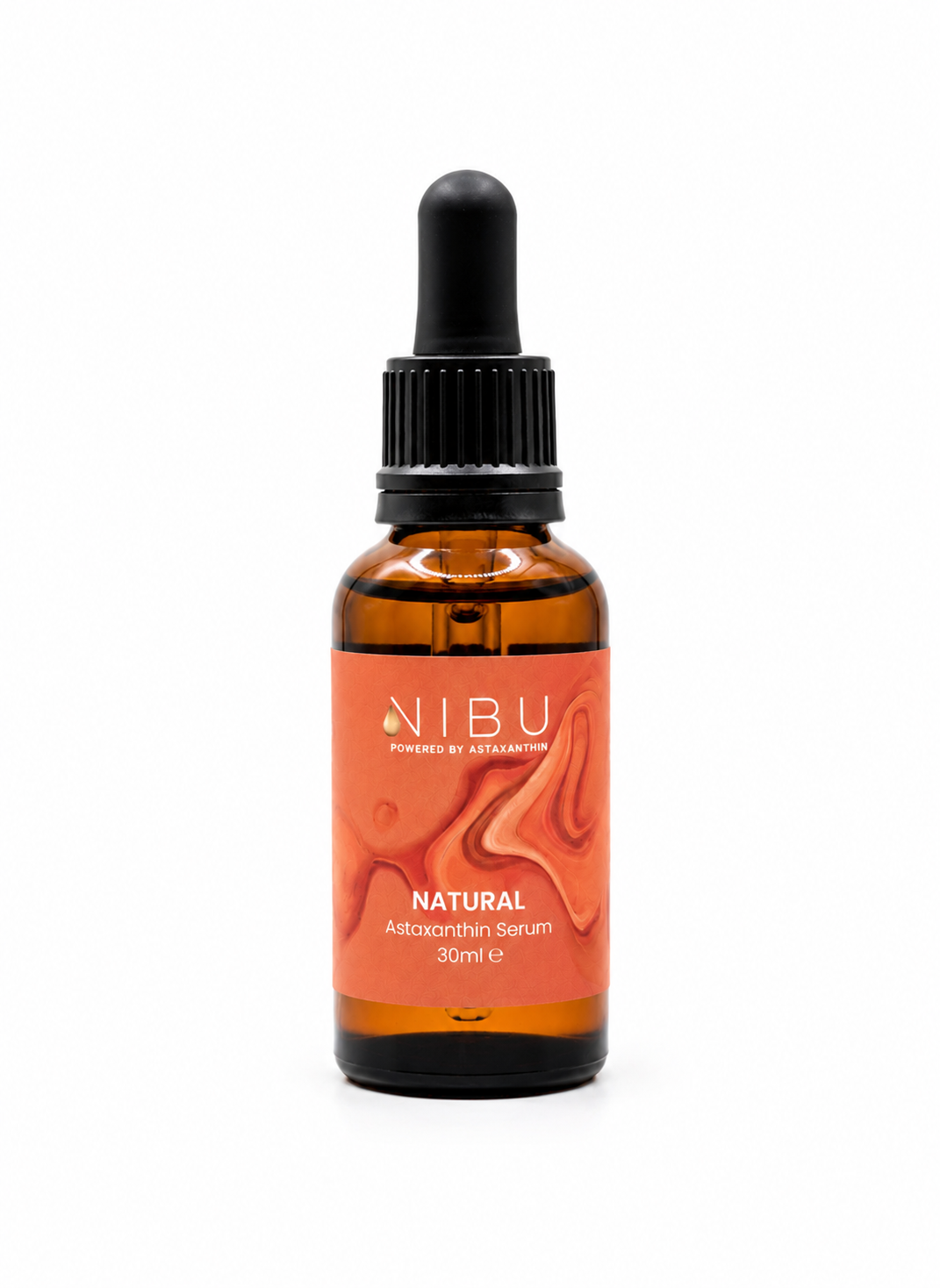
Our Astaxanthin supplement provides 8 mg of natural Astaxanthin from Haematococcus pluvialis per recommended daily serving.
We believe it is important to explain what that amount means, why source matters and how it fits into responsible supplementation.
No ingredient should be presented as the complete answer to healthy ageing. Nutrition, movement, sleep, strength, sun protection and everyday habits remain the foundations.
Supplements should support those foundations, not replace them.
Myth vs Fact: Astaxanthin Safety
| Myth | Fact |
|---|---|
| Natural supplements cannot cause side effects | Natural ingredients can still cause unwanted reactions |
| Astaxanthin is completely risk-free | Safety depends on dose, formulation and individual circumstances |
| More Astaxanthin means better results | Higher doses are not automatically more effective |
| Everyone needs to take Astaxanthin | It is an optional supplement, not an essential nutrient |
| You must cycle Astaxanthin | No routine cycling requirement has been established |
| Astaxanthin is proven to interact with blood thinners | Direct evidence is limited; professional advice is a sensible precaution |
| An 8 mg dose is appropriate for every age | Age-specific safety and authorisation conditions apply |
Frequently Asked Questions
| Question | Answer |
|---|---|
| What are the most common Astaxanthin side effects? | There is no well-established list of common side effects at typical adult doses. Short-term human studies generally report good tolerability, although digestive discomfort or individual reactions are possible. |
| Is Astaxanthin safe to take every day? | EFSA concluded that 8 mg daily from supplements was safe for adults under the assessed exposure conditions. Individual health circumstances still matter. |
| Is 8 mg of Astaxanthin too much? | An 8 mg daily supplement intake was specifically assessed as safe for adults by EFSA. This does not mean higher doses are automatically advisable. |
| Can Astaxanthin damage your liver? | A consistent liver-toxicity signal has not been established at the evaluated adult intake. People with liver disease should seek medical advice before supplementation. |
| Can Astaxanthin affect blood pressure? | Preliminary research has investigated cardiovascular effects, but reliable evidence of a clinically meaningful interaction with blood-pressure medicines is limited. |
| Can you take Astaxanthin with blood thinners? | Ask your pharmacist or prescribing clinician first. Direct interaction studies are limited. |
| Is Astaxanthin safe during pregnancy? | There is insufficient direct human evidence to establish safety during pregnancy. Do not start supplementation without professional advice. |
| Can Astaxanthin affect hormones? | There is no convincing human evidence that ordinary Astaxanthin supplementation reliably balances female hormones. |
| Should Astaxanthin be taken with food? | Yes. Astaxanthin is fat-soluble, so taking it with a meal containing dietary fat is a sensible approach. |
| Do you need to take breaks from Astaxanthin? | No routine cycling requirement has been established, although long-term human evidence remains limited. |
| Can you take Astaxanthin and omega-3 together? | There is no established general requirement to separate them. However, check whether your omega-3 supplement already contains Astaxanthin and avoid unintended duplication. |
| Can Astaxanthin replace a healthy diet? | No. Astaxanthin supplementation should complement, not replace, varied nutrition and healthy lifestyle habits. |
Key Takeaways
- Astaxanthin has generally been well tolerated in available short-term human studies.
- EFSA assessed 8 mg daily from supplements as safe for adults alongside high estimated dietary exposure.
- There is no well-established pattern of common serious side effects at the assessed intake.
- Digestive discomfort and individual reactions are possible.
- Long-term human studies spanning many years remain limited.
- Medication interactions have not been adequately investigated in humans.
- Pregnancy, breastfeeding and significant medical conditions warrant individual advice.
- Higher doses are not automatically better.
- Check for Astaxanthin in other supplements to avoid duplication.
- Quality, transparency and following the recommended serving are important.
The Nibu Longevity Take
At Nibu, we have always believed that understanding an ingredient is just as important as being excited about it.
Astaxanthin is where our story began. It inspired our skincare range and helped shape our interest in antioxidant science, skin health and healthy ageing from the inside and the outside.
But our enthusiasm for Astaxanthin doesn't mean we should overlook questions about safety. In fact, those questions are part of what makes responsible health education so valuable.
When you understand what an ingredient does, how much has been studied and where precautions are needed, you can make decisions with greater confidence.
And confidence is a wonderful thing. It means choosing a supplement because you understand its place in your routine, not because someone has promised extraordinary results.
Healthy ageing will always involve more than a capsule. It is built through nourishing meals, regular movement, restful sleep, maintaining strength and looking after your skin.
Astaxanthin may have a place within that wider picture. But the foundation is always the same.
The best healthy-ageing choices begin with understanding.
Conclusion
So, is Astaxanthin safe to take every day? For healthy adults, the available evidence is reassuring at the 8 mg daily supplement intake evaluated by EFSA.
That provides a useful scientific foundation for understanding everyday use. However, no supplement is automatically appropriate for every individual.
Medication use, pregnancy, breastfeeding, medical conditions and combining supplements all deserve consideration.
The most sensible approach is to choose a quality-controlled product, follow its recommended serving and keep supplementation in perspective.
At Nibu, we believe good information should make healthy ageing feel clearer, not more complicated. And understanding safety is an important part of that journey.
References
- EFSA Panel on Nutrition, Novel Foods and Food Allergens. Safety of astaxanthin for its use as a novel food in food supplements. EFSA Journal. 2020;18(2).
- European Commission. Commission Implementing Regulation (EU) 2023/1581, amending the conditions of use of Astaxanthin-rich oleoresin from Haematococcus pluvialis. 2023.
- European Commission. Commission Implementing Regulation (EU) 2021/1377, amending the conditions of use of Astaxanthin-rich oleoresin from Haematococcus pluvialis. 2021.
- Spiller GA, Dewell A. Safety of an astaxanthin-rich Haematococcus pluvialis algal extract: a randomized clinical trial. Journal of Medicinal Food. 2003;6(1):51–56.
- Zhou X, Cao Q, Orfila C, Zhao J, Zhang L. Systematic Review and Meta-Analysis on the Effects of Astaxanthin on Human Skin Ageing. Nutrients. 2021;13(9):2917.
- Mercke Odeberg J, Lignell Å, Pettersson A, Höglund P. Oral bioavailability of the antioxidant astaxanthin in humans is enhanced by incorporation of lipid based formulations. European Journal of Pharmaceutical Sciences. 2003;19(4):299–304.
Continue Reading
Explore more evidence-led guides from The Nibu Journal:
- The Complete Guide to Astaxanthin: Benefits, Dosage, Safety and How It Works
- When Is the Best Time to Take Astaxanthin? Morning, Night or With Food?
- Astaxanthin Benefits for Skin
- Does Astaxanthin Protect Your Skin From the Sun?
- Oral vs Topical Astaxanthin: What's the Difference and Can You Use Both?
- Icelandic Astaxanthin for Skin: Why the Source Matters
- Oxidative Stress Explained: Why It Matters for Healthy Ageing
About The Nibu Journal
The Nibu Journal is the educational home of Nibu Naturals, a female-founded British healthy-ageing brand.
Nibu began with Astaxanthin skincare and has evolved into a wider mission encompassing nutrition, evidence-led supplements, women's health and everyday lifestyle education.
Our philosophy is Healthy Ageing, Inside & Out.
We believe women deserve clear, trustworthy information that helps them make confident decisions about healthy ageing.
Educate first. Build trust. Create desire through understanding. Sell naturally.
Medical Disclaimer
This article provides general educational information and does not replace personalised medical advice.
Astaxanthin supplements are not intended to diagnose, treat, cure or prevent disease. If you are pregnant, breastfeeding, taking medication or managing a medical condition, consult an appropriately qualified healthcare professional before starting supplementation.

Read more
When Is the Best Time to Take Creatine? Morning, Night or After Exercise?
Morning, evening or after exercise? When it comes to creatine, the most effective routine may be simpler than you think. Discover what the research says about timing, daily consistency and how wome...
Read more
Introducing Nibu Soul: A New Chapter with Nici
Nici shares a personal update on her spiritual journey and introduces Nibu Soul, a new independent business focused on spiritual wellbeing, personal reflection and reconnection. Coming soon.
Read moreShop
Best Sellers