Artikel: When Is the Best Time to Take Astaxanthin? Morning, Night or With Food?
When Is the Best Time to Take Astaxanthin? Morning, Night or With Food?
Quick Answer
There is no good evidence that Astaxanthin must be taken in the morning or at night. What appears more important is how you take it.
Astaxanthin is a fat-soluble carotenoid, and human research indicates that its absorption can be substantially influenced by food and the composition of the meal. Taking Astaxanthin with a meal containing some dietary fat is therefore a sensible approach.
That could be:
- breakfast with yoghurt, eggs, nuts or avocado
- lunch containing olive oil, fish, cheese or nuts
- dinner containing an appropriate source of dietary fat
You do not need a particularly high-fat meal. And unless the instructions on your particular supplement say otherwise, there is no compelling reason to obsess over the clock.
For most women, the practical answer is: take Astaxanthin with a meal you eat consistently and make it part of your normal routine.
What You'll Learn
In this guide we'll answer:
- should Astaxanthin be taken in the morning or at night?
- should you take Astaxanthin with food?
- why does dietary fat matter?
- can you take Astaxanthin on an empty stomach?
- does coffee affect Astaxanthin?
- can you take it with omega-3?
- can you take it with creatine?
- should you take Astaxanthin every day?
- how long does Astaxanthin take to work?
- is there an ideal dose?
- what is the easiest way to build Astaxanthin into your routine?
Morning or Night? Let's Make Astaxanthin Simpler
Supplement routines can become surprisingly complicated. Take this one before breakfast. That one after breakfast. This one with fat. That one without food. Another one two hours away from everything else.
Before long, your kitchen table looks like a dispensary and you need a spreadsheet to eat breakfast.
Astaxanthin does not need to be that complicated. For most people, the question “Should I take Astaxanthin in the morning or at night?” is probably less important than “Am I taking it in a way that supports absorption and that I can remember consistently?”
And to understand why, we need to look at what Astaxanthin actually is.
Why Astaxanthin Is Different From a Water-Soluble Nutrient
Astaxanthin is a naturally occurring red-orange carotenoid. It belongs to a group of carotenoids called xanthophylls and is produced naturally by organisms including the microalga Haematococcus pluvialis.
One of the characteristics that matters when taking Astaxanthin is that it is lipophilic, or fat-soluble. In simple terms: Astaxanthin gets along with fat better than it gets along with water.
That matters because fat-soluble compounds behave differently during digestion from water-soluble nutrients. Before Astaxanthin can circulate around the body, it first has to be released from what you have consumed, incorporated into structures involved in fat digestion and absorbed through the intestine.
Meal composition can therefore influence how much reaches the bloodstream.
Should You Take Astaxanthin With Food?
Yes, taking it with food is a sensible choice.
One of the most useful human studies in this area investigated Astaxanthin absorption under different conditions. Researchers found that Astaxanthin bioavailability was considerably higher when taken after a meal than before one.
Other research examining carotenoid absorption supports the broader principle that dietary lipids can improve the bioavailability of carotenoids because of the role fat plays in digestion and micelle formation.
This gives us a very practical recommendation: take your Astaxanthin with a meal rather than making it another supplement you have to remember on an empty stomach.
Why Does Fat Help Astaxanthin Absorption?
Imagine trying to mix oil into a glass of water. They naturally separate. The digestive system faces a similar challenge with fat-soluble substances.
When you eat dietary fat, digestion stimulates processes including the release of bile and formation of tiny structures known as mixed micelles. These help transport fat-soluble molecules through the watery environment of the digestive tract towards the intestinal surface where absorption can occur.
Carotenoids can become incorporated into these structures. After absorption, Astaxanthin is transported within lipoproteins through the circulation.
You don't need to remember the biochemistry. Just remember: Astaxanthin is fat-soluble, so taking it alongside a meal containing some fat makes biological sense.
How Much Fat Do You Need?
This is where we should avoid turning useful science into another wellness rule. You do not need to eat an enormous high-fat meal just to take Astaxanthin. A normal balanced meal containing dietary fat is perfectly reasonable.
For example:
Breakfast
- Greek yoghurt with nuts and berries
- eggs with wholegrain/sourdough toast
- porridge with nuts or seeds
Lunch
- salad dressed with olive oil
- wholegrain/sourdough toast with avocado
- a meal containing oily fish
Dinner
A balanced meal containing fish, olive oil, avocado, nuts, seeds, dairy or another source of dietary fat.
The point is not “Eat lots of fat with Astaxanthin.” It is “Don't be afraid to take a fat-soluble carotenoid with an ordinary meal containing some fat.”
Is Breakfast the Best Time to Take Astaxanthin?
Breakfast is an excellent option. But not because Astaxanthin somehow knows it is 8 am.
Breakfast works particularly well if:
- you eat breakfast consistently
- your breakfast contains some fat
- you already take other suitable daily supplements then
- attaching the capsule to breakfast helps you remember it
This is why at Nibu we often like the idea of Astaxanthin becoming part of a simple morning routine. It is practical. And healthy habits become much easier when they are attached to things we already do.
But if breakfast for you is just black coffee, lunch or dinner may make more sense.
Can You Take Astaxanthin at Night?
Yes. There is no established evidence that Astaxanthin needs to be taken in the morning rather than the evening.
If dinner is your most consistent meal, taking it with dinner may be easier. Likewise, if you remember supplements better in the evening, that can be a perfectly practical routine.
The key point is: we do not currently have good human evidence demonstrating that a particular time of day produces superior Astaxanthin benefits. So there is little value in inventing a morning-versus-night rule that the evidence doesn't support.
Does Astaxanthin Give You Energy?
This question probably explains some of the confusion about taking it in the morning.
Astaxanthin has been studied in areas including exercise, oxidative stress and cellular biology. But it is not a stimulant. It does not work like caffeine. Taking Astaxanthin should not be thought of as giving you an immediate energy boost.
That means there is no obvious reason most people would need to avoid it in the evening because they are worried about it “keeping them awake”.
Does Astaxanthin Help You Sleep?
This is another example of research being stretched too far online. There is emerging scientific interest in relationships between oxidative stress, sleep and carotenoids, but Astaxanthin is not an established sleep treatment.
We would not recommend choosing your Astaxanthin timing based on the expectation that it will make you sleepy.
If sleep is your concern, the fundamentals still matter enormously:
- sufficient sleep opportunity
- consistent timing
- light exposure
- physical activity
- alcohol and caffeine habits
- addressing sleep disorders where necessary
A supplement should not distract from those foundations.
Can You Take Astaxanthin on an Empty Stomach?
You probably can, but it is unlikely to be the most sensible routine if you want to support absorption. Human pharmacokinetic research suggests food can substantially affect Astaxanthin bioavailability.
So unless you have been given different instructions for a particular product: with a meal is the more logical option. This also makes it easier to turn supplementation into a consistent habit.
Can You Take Astaxanthin With Coffee?
There is no established requirement to separate Astaxanthin from ordinary coffee consumption. But there is a practical distinction.
If your “breakfast” is simply black coffee + Astaxanthin capsule, then you are missing the meal component that may help absorption.
That does not mean coffee is cancelling your Astaxanthin. It means taking it later with actual food may make more sense.
Can You Take Astaxanthin With Omega-3?
For most healthy adults, Astaxanthin and omega-3 do not automatically need to be separated into different parts of the day.
There is also a rather lovely natural connection between them. Astaxanthin is produced by microalgae and moves through aquatic food chains. It contributes to the characteristic colour of animals such as salmon.
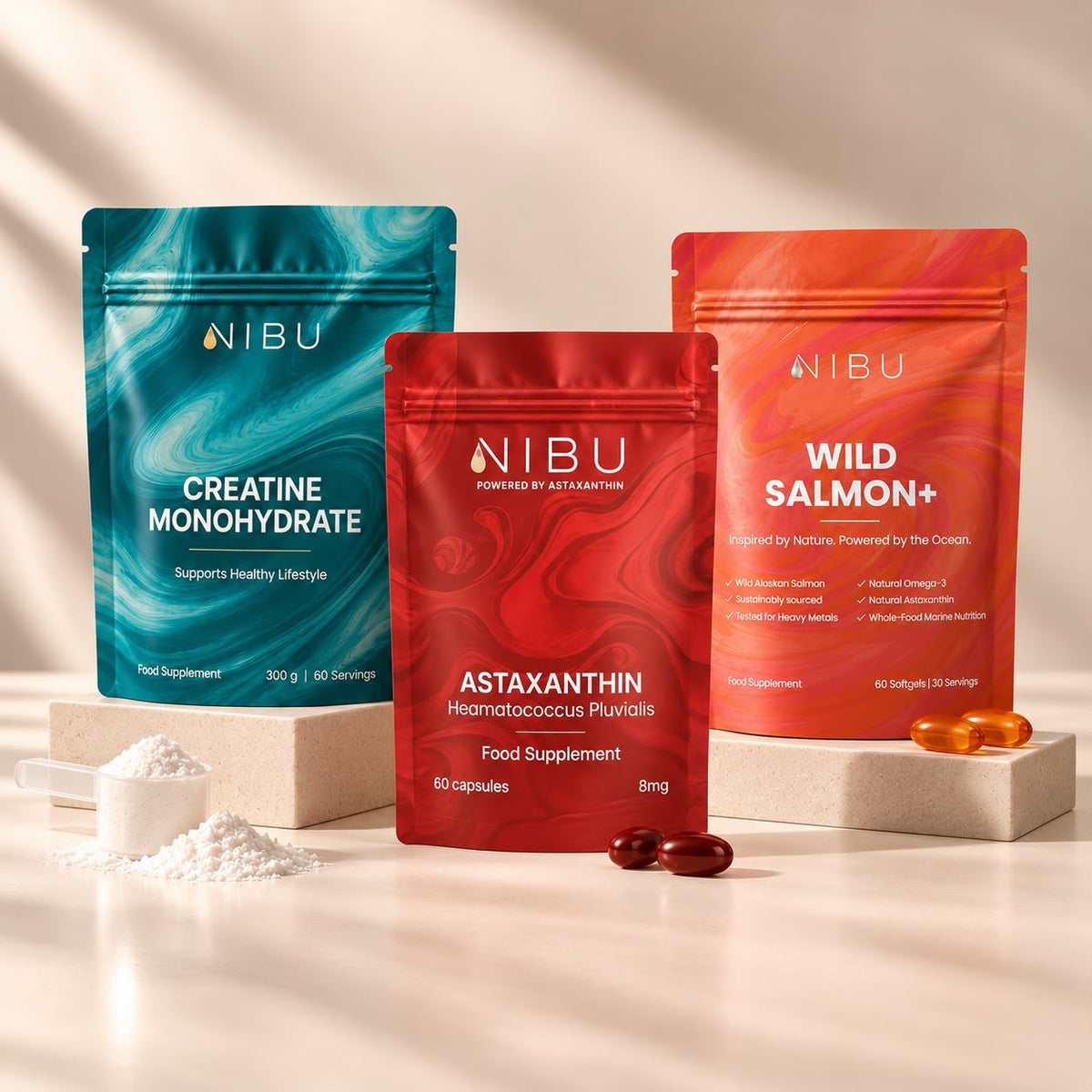
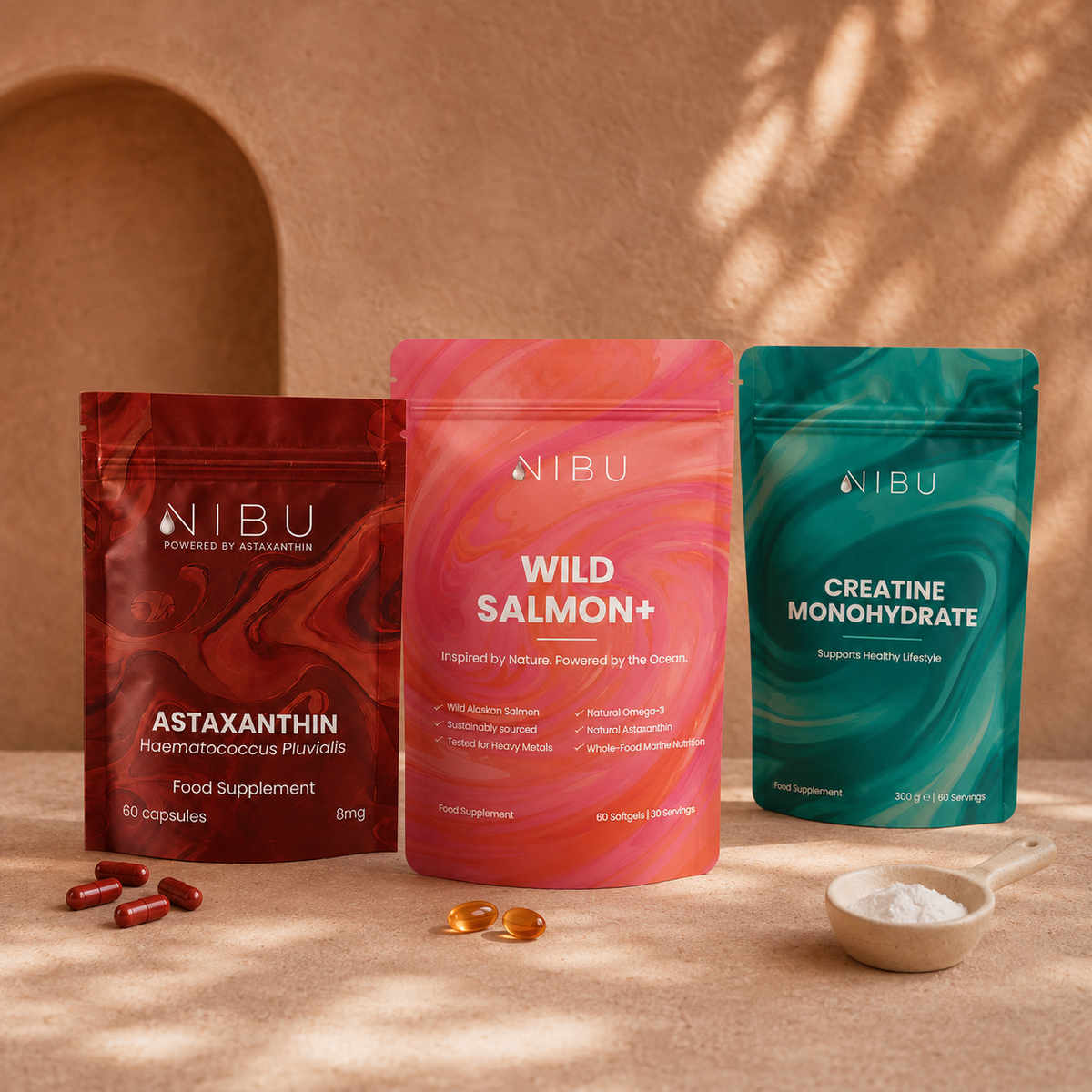
At Nibu, that makes the relationship particularly interesting because our wider healthy-ageing range includes Wild Salmon+ alongside Astaxanthin.
For women who use both, taking them with the same meal can also keep the routine beautifully simple. Wild Salmon+ is designed to be taken with food, while taking Astaxanthin alongside a meal containing dietary fat makes sense for its absorption.
They are still different nutritional compounds doing different things. One does not replace the other. But both can sit comfortably within a broader food-first healthy-ageing approach.
Can You Take Astaxanthin With Creatine?
There is no general requirement for healthy adults to take Astaxanthin and creatine at different times simply because they are different supplements.
Their biology is very different. Creatine supports the phosphocreatine system involved in rapid energy regeneration within cells. Astaxanthin is a carotenoid with antioxidant properties.
So rather than searching for a magical interaction between them, think about each according to its own evidence and purpose. For Nibu customers using both, the simplest routine is often the one that makes consistent use easiest.
Can You Take Astaxanthin, Creatine and Wild Salmon+ Together?
This is where Nibu's Healthy Ageing, Inside & Out philosophy is useful. The three supplements have not been created because they supposedly “boost” each other. They represent different nutritional areas.
Astaxanthin
A distinctive carotenoid antioxidant and the ingredient at the heart of Nibu's story.
Creatine
One of the most extensively researched nutritional compounds for muscle and physical performance, with growing research interest in women's healthy ageing and cognition.
Wild Salmon+
A source of Wild Alaskan salmon oil providing the marine omega-3 fatty acids EPA and DHA.
They do different jobs. That is precisely the point. If using all three, follow the directions on each product. There is no need to create an elaborate schedule purely to keep them apart.
Should You Take Astaxanthin Every Day?
Most human supplementation studies investigating Astaxanthin have used daily supplementation over a period of weeks. That makes daily use the pattern for which we have most research. It also makes practical sense.
Rather than: Monday yes. Tuesday forgotten. Wednesday two capsules because you missed Tuesday. Thursday maybe.
A consistent daily routine is much easier. Always follow the serving instructions for the product you are using rather than doubling a dose because you forgot one.
What Is the Best Astaxanthin Dose?
This deserves its own detailed discussion because there isn't one universally established “perfect” dose for every possible purpose.
Human studies have investigated a range of doses. Reviews of Astaxanthin research describe human trials using amounts including 4 mg, 6 mg, 8 mg and 12 mg per day, depending on the study population and outcome being investigated.
Nibu Astaxanthin provides 8 mg of Astaxanthin from Haematococcus pluvialis in the recommended daily serving. That sits within the range commonly investigated in human Astaxanthin research.
We don't need to claim that 8 mg is a magical threshold. What matters is that we chose a meaningful daily amount of naturally sourced Astaxanthin that fits comfortably within the existing research landscape.
Does More Astaxanthin Work Better?
Not necessarily. Nutrition rarely follows the rule: if some is useful, more must be better.
Different trials use different doses, durations and populations. You cannot simply compare one study using 4 mg with another using 12 mg and conclude that the larger dose must be superior.
Unless dose-response trials directly demonstrate that relationship, it remains an assumption. The goal should be an evidence-informed dose. Not the biggest number on the label.
How Long Does Astaxanthin Take to Work?
It depends entirely on what you mean by “work”. Astaxanthin is not like caffeine, where you can feel an obvious acute effect shortly after consuming it.
Clinical research generally investigates Astaxanthin over weeks rather than hours or days. For example, skin studies have commonly examined supplementation over periods of several weeks, with systematic reviews finding encouraging evidence particularly around skin moisture and elasticity.
That does not mean everyone will notice a visible difference after a particular number of weeks. Different outcomes may also require different periods of study.
A better way to approach Astaxanthin is: consistent use rather than expecting an immediate sensation.
Should You Cycle Astaxanthin?
There is no established evidence-based requirement for healthy adults to routinely “cycle” Astaxanthin by taking planned weeks on and off.
The idea of supplement cycling often comes from sports nutrition or pharmacology and gets applied to supplements whether it is necessary or not.
If you choose to take Astaxanthin, follow the recommended directions and periodically consider whether the supplement still fits your needs. Simple.
Why Nibu Chose Astaxanthin
This is where Nibu's story is slightly unusual. We did not discover Astaxanthin because we wanted another supplement. We discovered it through skincare.
Astaxanthin became the ingredient around which Nibu's original skincare philosophy was built. Its distinctive red colour, its carotenoid chemistry and the emerging research around oxidative stress and skin health fascinated us.
As Nibu evolved into a wider women's healthy-ageing brand, exploring Astaxanthin nutritionally was a natural extension of that story.
Today it sits on both sides of our philosophy: Healthy Ageing, Inside & Out.
Topically, Astaxanthin remains at the heart of our skincare heritage. Nutritionally, Nibu Astaxanthin provides 8 mg from Haematococcus pluvialis per daily serving.
Same fascinating carotenoid. Different route. Different role. One ingredient that continues to sit at the heart of Nibu.
A Simple Nibu Astaxanthin Routine
There is no need to turn this into a complicated protocol.
- Choose a meal. Breakfast, lunch or dinner.
- Make sure the meal contains some dietary fat. Nothing excessive. Just a normal balanced meal.
- Take the recommended daily serving. Follow the directions on your Astaxanthin supplement.
- Attach it to an existing habit. For example, “Breakfast → Astaxanthin” is easier to remember than “Take Astaxanthin at some random point today.”
- Be consistent. Healthy habits usually work better when they become boringly normal.
That is it. No complicated timing protocol required.
Morning vs Night vs With Food
| Question | Nibu's evidence-led answer |
|---|---|
| Morning or night? | Either is reasonable |
| With food? | Yes, this is the sensible option |
| With dietary fat? | Recommended because Astaxanthin is fat-soluble |
| Empty stomach? | Probably not the ideal approach |
| With breakfast? | Excellent if breakfast contains some fat |
| With dinner? | Also perfectly reasonable |
| With coffee? | No known need to separate, but coffee alone isn't a meal |
| With omega-3? | Generally no need to separate for healthy adults |
| With creatine? | Generally no need to separate |
| Every day? | Daily use is how most supplementation research has been conducted |
| Cycle it? | No established requirement |
| Most important factor? | A consistent routine with food |
Myth vs Fact
| Myth | Fact |
|---|---|
| Astaxanthin has to be taken in the morning. | There is no established evidence showing morning supplementation is superior. |
| Astaxanthin should be taken before bed. | There is no established evidence showing night-time supplementation provides greater benefit. |
| Astaxanthin gives you an immediate energy boost. | Astaxanthin is not a stimulant like caffeine. |
| You should take Astaxanthin on an empty stomach. | Human research indicates food can substantially influence Astaxanthin bioavailability. |
| You need a very fatty meal. | Astaxanthin is fat-soluble, but this does not mean you need an excessive amount of dietary fat. |
| More Astaxanthin must be better. | Different doses have been studied, and a larger dose cannot automatically be assumed to produce greater benefit. |
| You need to cycle Astaxanthin. | There is no established requirement for routine cycling. |
Frequently Asked Questions
| Question | Answer |
|---|---|
| What is the best time of day to take Astaxanthin? | There is no proven best time. Morning, lunchtime or evening can all work. Taking it consistently with a meal is likely more important than the precise time. |
| Should I take Astaxanthin with breakfast? | Yes, particularly if breakfast contains some dietary fat. |
| Should Astaxanthin be taken with food? | This is a sensible approach. Astaxanthin is fat-soluble, and human research indicates that meal timing and composition can influence its absorption. |
| Should I take Astaxanthin with fat? | Yes. Taking it alongside an ordinary meal containing some dietary fat is a practical way to support absorption. |
| Can I take Astaxanthin on an empty stomach? | You can potentially take it this way, but taking it with a meal is likely a more sensible approach given its fat-soluble nature. |
| Can I take Astaxanthin at night? | Yes. There is no good evidence that it must be taken earlier in the day. |
| Will Astaxanthin keep me awake? | Astaxanthin is not a stimulant, and there is no established evidence that ordinary supplementation has a caffeine-like stimulating effect. |
| Can I take Astaxanthin with omega-3? | There is generally no requirement for healthy adults to separate the two solely because they are different supplements. |
| Can I take Astaxanthin and creatine together? | There is no general requirement to separate them by time of day. |
| How much Astaxanthin should I take? | Follow the directions for your particular supplement. Human studies have investigated several daily doses, and there is no universally established optimal amount for every health outcome. |
| How much Astaxanthin is in Nibu Astaxanthin? | Nibu provides 8 mg of Astaxanthin from Haematococcus pluvialis in the recommended daily serving. |
| How long should I take Astaxanthin? | Research generally studies consistent supplementation over weeks or months rather than occasional use. Long-term suitability depends on the individual and should be considered alongside health conditions and medicines. |
Key Takeaways
- There is no established best clock time for taking Astaxanthin.
- Morning and evening are both reasonable.
- Astaxanthin is fat-soluble.
- Taking it with a meal containing dietary fat is a sensible way to support absorption.
- You do not need an extremely high-fat meal.
- You generally don't need to separate Astaxanthin from creatine or omega-3 simply because they are different supplements.
- Astaxanthin is not a stimulant.
- Daily supplementation is the pattern most commonly used in human research.
- Different Astaxanthin doses have been studied, so bigger does not automatically mean better.
- Nibu Astaxanthin provides 8 mg from Haematococcus pluvialis per daily serving.
And for most women, the easiest routine will be: choose a meal. Take it consistently. Get on with your day.
The Nibu Longevity Take
There is a strange tendency in wellness to make simple things complicated. A supplement isn't more effective because your routine sounds impressive.
You do not need to wake at 5.47 am, drink a special concoction and wait precisely 23 minutes before taking your Astaxanthin. Healthy ageing rarely works like that.
The better question is: can I make this part of a routine I will actually maintain?
Astaxanthin is an ingredient Nibu has believed in from the beginning. Long before it became one of our supplements, it sat at the heart of our skincare.
And the more we have learned about this remarkable carotenoid, the more fascinating it has become. Its distinctive structure. Its relationship with oxidative stress. Its emerging human research. Its connection with skin. Its place in the natural world, from microalgae through the marine food chain.
That is why Astaxanthin remains our hero ingredient.
If you choose to make it part of your healthy-ageing routine, you don't need to overthink it. Take it with a meal. Take it consistently. Then focus on the bigger picture.
Move. Eat well. Build muscle. Sleep. Look after your skin. Enjoy your life.
Because Astaxanthin can support your routine. The routine is still yours to build.
Conclusion
So, when is the best time to take Astaxanthin? The answer is reassuringly simple: whenever you can take it consistently with a meal containing some dietary fat.
For many women, breakfast will be easiest. For others, lunch or dinner will make more sense.
The evidence does not currently give us a reason to insist on morning or evening. What we do know is that Astaxanthin is fat-soluble and its absorption is influenced by the conditions in which it is consumed.
So instead of worrying about the clock: think food, think consistency, and keep the routine simple.
For us, Astaxanthin has never been about creating another complicated wellness ritual. It is about making one fascinating, extensively studied carotenoid an easy part of everyday healthy ageing.
Choose a meal. Take it consistently. And let Astaxanthin become one of those small habits that simply becomes part of your day.
References
- Okada Y, Ishikura M, Maoka T. Bioavailability of Astaxanthin in Haematococcus Algal Extract: The Effects of Timing of Diet and Smoking Habits. Bioscience, Biotechnology, and Biochemistry. 2009;73(9):1928–1932. Human pharmacokinetic research examining the influence of meal timing on Astaxanthin bioavailability.
- Mercke Odeberg J, Lignell Å, Pettersson A, Höglund P. Oral Bioavailability of the Antioxidant Astaxanthin in Humans Is Enhanced by Incorporation of Lipid Based Formulations. European Journal of Pharmaceutical Sciences. 2003;19(4):299–304. Research demonstrating the importance of formulation and lipids for Astaxanthin bioavailability.
- Ambati RR, Phang SM, Ravi S, Aswathanarayana RG. Astaxanthin: Sources, Extraction, Stability, Biological Activities and Its Commercial Applications. Marine Drugs. 2014;12(1):128–152. Review of Astaxanthin's chemistry, natural sources and biological properties.
- Donoso A, González-Durán J, Muñoz AA, González PA, Agurto-Muñoz C. Therapeutic Uses of Natural Astaxanthin: An Evidence-Based Review Focused on Human Clinical Trials. Pharmacological Research. 2021;166:105479. Review of human Astaxanthin research across investigated health outcomes.
- Brendler T, Williamson EM. Astaxanthin: How Much Is Too Much? A Safety Review. Phytotherapy Research. 2019;33(12):3090–3111. Review examining Astaxanthin safety and doses used across research.
- Zhou X, Cao Q, Orfila C, Zhao J, Zhang L. Systematic Review and Meta-Analysis on the Effects of Astaxanthin on Human Skin Ageing. Nutrients. 2021;13(9):2917. Review and meta-analysis reporting encouraging evidence for oral Astaxanthin in skin moisture and elasticity.
- Ng QX, De Deyn MLZQ, Loke W, et al. Effects of Astaxanthin Supplementation on Skin Health: A Systematic Review of Clinical Studies. Journal of Dietary Supplements. 2021;18(2):169–182.
Continue Reading
- The Complete Guide to Astaxanthin: Benefits, Dosage, Safety and How It Works
- Astaxanthin Benefits: The Complete Evidence-Based Guide
- Astaxanthin Benefits for Skin: What Does the Science Actually Say?
- Oral vs Topical Astaxanthin: What's the Difference and Can You Use Both?
- Astaxanthin vs Other Antioxidants: How Does It Compare with Vitamin C, Vitamin E and CoQ10?
- Icelandic Astaxanthin for Skin: Why the Source Matters
- Oxidative Stress Explained: Why It Matters for Healthy Ageing
About The Nibu Journal
The Nibu Journal is the educational home of Nibu Naturals, a women's healthy-ageing brand built around the philosophy Healthy Ageing, Inside & Out.
Nibu began with Astaxanthin skincare. What started as a fascination with one distinctive carotenoid has grown into a wider mission to help women understand healthy ageing through clear, evidence-led education.
Today we explore skin health, nutrition, supplements, strength, women's health and lifestyle while continuing to build one of the most useful resources we can around the ingredient that started Nibu.
Astaxanthin remains at the heart of our story.
Medical Disclaimer
This article is for general educational purposes and is not intended to diagnose, treat, cure or prevent disease.
Food supplements should not be used as a substitute for a varied, balanced diet and healthy lifestyle.
If you are pregnant or breastfeeding, have a medical condition, take prescription medicines or are unsure whether Astaxanthin is appropriate for you, speak to your GP, pharmacist or another appropriately qualified healthcare professional before supplementation.

Read more

Fibre for Women: Why It Matters More Than You Might Think
Fibre does far more than keep you regular. It supports bowel health, feeds parts of the gut microbiome and is associated with better cardiovascular and metabolic health. Yet most UK adults eat far ...
WeiterlesenShop
Bestseller